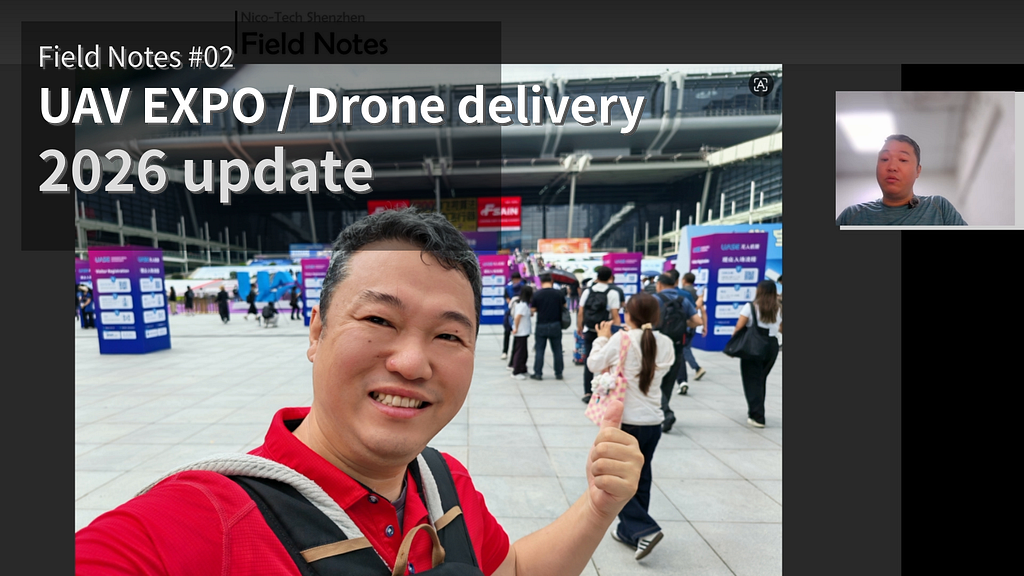
I visited the international UAV Expo in Shenzhen. I have been following this exhibition almost every year since the post-pandemic period around 2022, and I have also written several reports about China’s drone industry over the years. Because of that, this year’s change was very clear to me.
To be honest, for the past few years, this drone exhibition was not always the most exciting event. By around 2018 or 2019, DJI had already become overwhelmingly strong in camera drones and many types of professional drone applications. If you wanted to build a drone-based solution, the fastest answer was often simple: ask DJI, buy DJI products, and build around them.
That made the rest of the drone exhibition feel a little predictable. Many non-DJI exhibitors were showing large drones for local governments, police, firefighting, emergency response, or military-related use cases. Some of them looked impressive. There were drones with many large rotors, drones that could supposedly carry fire hoses, and drones designed for disaster or security operations.
But it was not always clear how much of this was actually being used in daily operations. Some booths had mockups. Some had impressive explanations, but not much evidence of real deployment. In many cases, simply appearing at an exhibition seemed to be part of an appeal to government buyers or subsidy programs.
This year felt different.
https://youtu.be/ONTOW8gMeQ4A Drone Exhibition That Suddenly Became Crowded AgainThe Shenzhen UAV Expo this year used a large part of the Futian Convention and Exhibition Center, and the number of visitors was much higher than I expected. But what mattered was not only the size of the event. The type of visitors and the type of booths had changed.
Instead of simply looking at finished drones, many visitors were seriously talking to companies providing RTK positioning, motors, control systems, communication modules, and other components. At some RTK booths, I saw people from Europe, the United States, and other regions having serious business discussions.
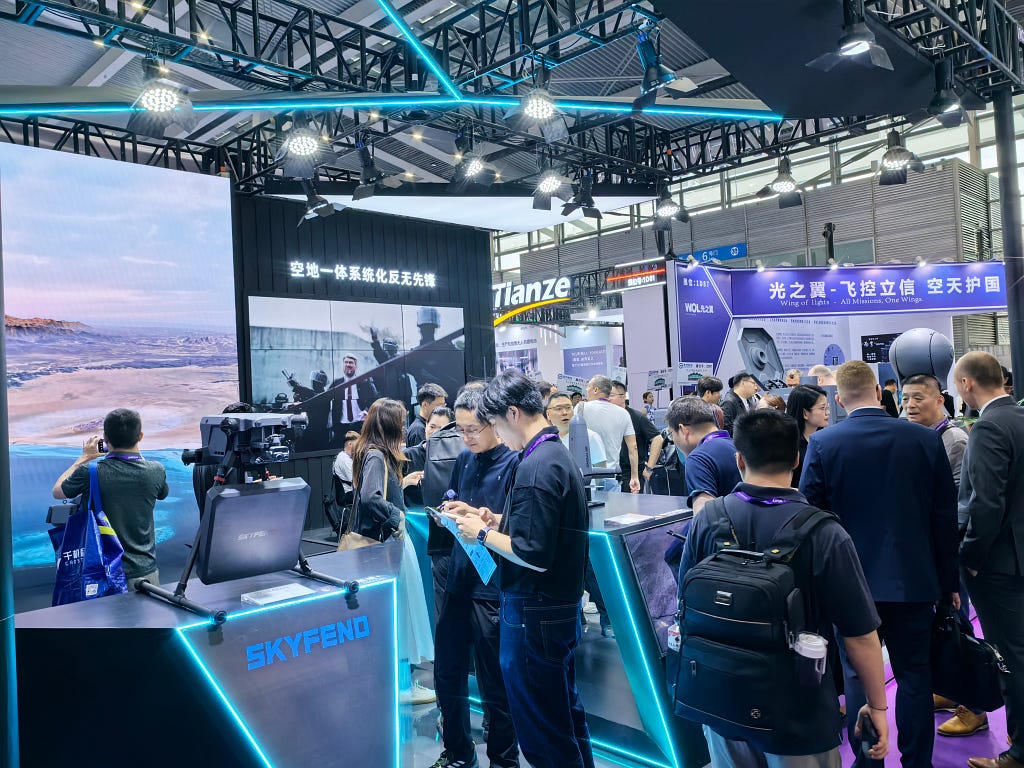
RTK, or real-time kinematic positioning, is not only a drone technology. It is also used in surveying, robotics, autonomous vehicles, and large outdoor field experiments. For example, when robots need to know their position accurately in a large outdoor environment, the same kind of technology becomes important.
This is one reason why drones and AI robots are becoming much closer than many people think. A drone needs positioning, sensing, motor control, communication, path planning, obstacle avoidance, and sometimes SLAM or AI-based perception. A ground robot needs many of the same things. The difference is whether the machine moves on legs, wheels, or rotors.
In the past, I sometimes described drones as “flying smartphones.” That is still useful in one sense. A drone is not just a flying object. It is a combination of camera modules, batteries, motors, sensors, communication systems, software, AI, and applications. But after seeing this year’s exhibition, I feel that drones are now becoming even closer to “flying AI robots.”The Return of the BuilderWhat stood out this year was the return of the builder side of the drone industry.
There were many booths for brushless motors, servo motors, positioning modules, educational drone kits, and systems designed to help students understand how drones work internally. The message was not only “buy this drone.” It was also “understand how drones are made,” “combine these parts,” and “optimize your own system.”
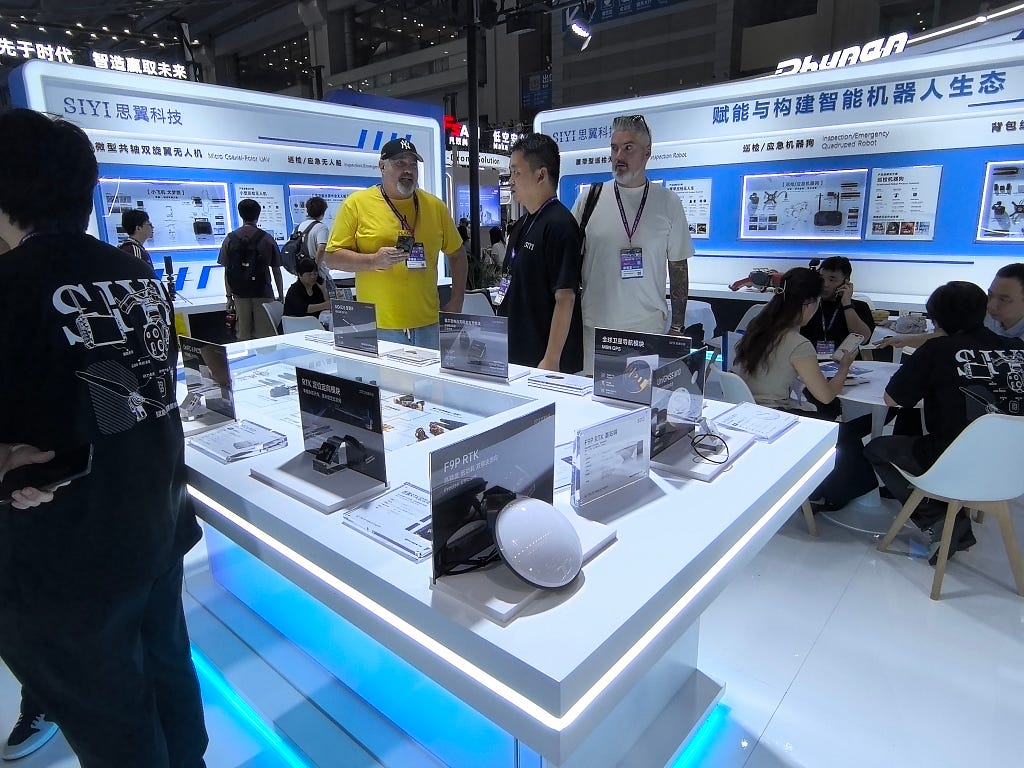
This is happening not only in China. Around the world, more countries and companies now want to develop their own drones. In Japan, for example, there is a strong preference in some areas for domestic drones instead of Chinese products. In other countries, security concerns, supply chain issues, or the war in Ukraine have pushed people to think more seriously about drone independence.
Of course, if you simply want a useful drone today, buying a DJI product is often still the fastest and most practical answer. But if you want to optimize a drone for a specific purpose, or if you want to understand and control the system yourself, you eventually need to go deeper than buying a finished product.
That is what made this year’s Shenzhen UAV Expo interesting. It was not just a product show. It felt more like an ecosystem show for people who want to build.Passenger Drones Are Still Hard to Believe as a Daily ServiceThere were also many passenger drones at the venue. These booths are always popular because they look impressive. A drone large enough to carry people naturally attracts attention.
But I am still not convinced that passenger drones are already becoming a normal service that ordinary people can use.
There are many press releases. There are many announcements about commercial operations. There are videos of test flights. But when I ask a very simple question — where can I go, how much do I pay, and how can I actually ride one? — the answer becomes much less clear.
I live in Shenzhen, and I spend a lot of time and money trying new technologies on the ground. I have taken robotaxis, visited robotics companies, and followed many field experiments. But I have still never taken a passenger drone. Even among people in the industry, it is not easy to find someone who has actually experienced it as a normal service.
This does not mean passenger drones are meaningless. But for now, I feel that the gap between the exhibition booth and everyday use is still large.Anti-Drone Systems and the Shadow of WarAnother strong theme at the exhibition was anti-drone technology.
This is probably influenced by the war in Ukraine and the increasing importance of drones in modern conflict. I saw drones designed to catch other drones with nets, anti-drone systems, and devices that looked almost like missiles. Some companies explained them as systems for long-distance monitoring with cameras, but in some cases it was not completely clear what the real intended use was.
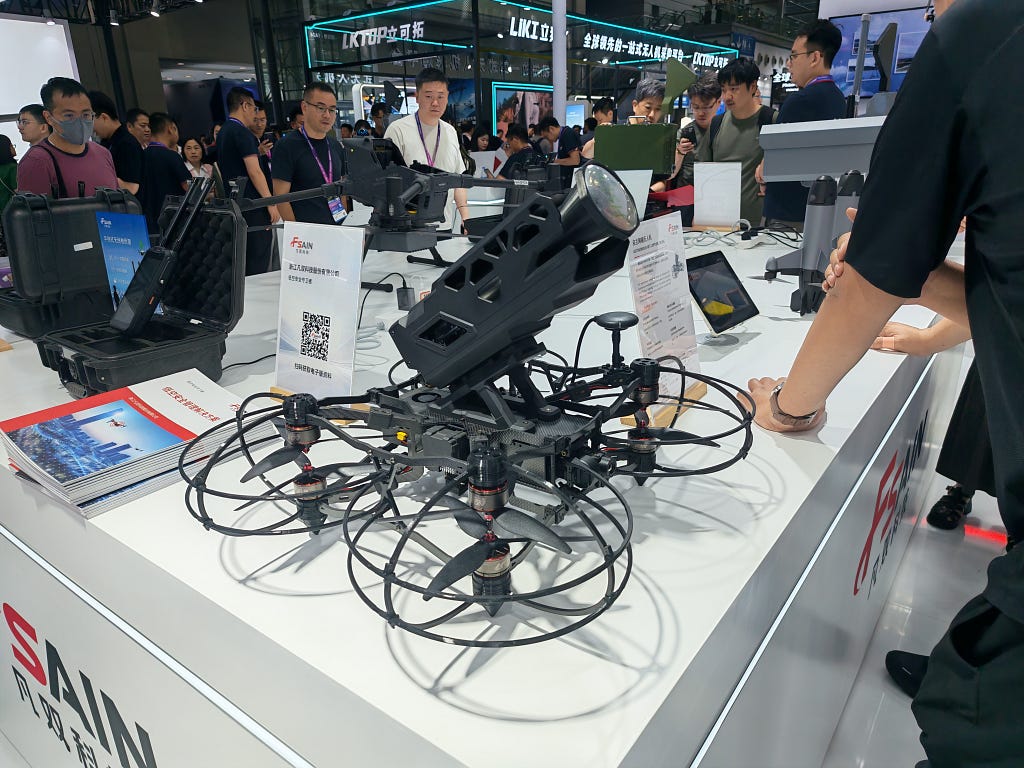
These systems looked futuristic and sometimes a little surreal. But they also showed how quickly drone technology has moved from hobby, photography, and industrial use into security and military contexts.
At the same time, I am not sure all of these products are practical. Even for military or police use, if the people operating the system cannot understand it clearly, they cannot really use it. This is another area where exhibitions can become more about imagination than actual deployment.Meituan Drone Delivery Is Already Part of Shenzhen’s RealityOn the other hand, there is one kind of drone service that you can actually experience in Shenzhen: Meituan drone delivery.
I have been following Meituan’s drone delivery experiments since around 2018. In the early days, the operation was still very manual. Delivery workers brought food to a station, staff weighed it, loaded it onto drones by hand, and communicated by radio before each flight. It was called automation, but in reality, it was supported by a lot of human work.
This time, after seeing Meituan’s latest drone model at the exhibition, I asked the team where I could see the new generation of delivery station in the city. They told me about a site in Longhua, so I went there to see it.
The new station was very interesting.
In the older model, the distribution center and receiving station were separate. One station sent packages to multiple receiving points. But the new generation station can handle both sending and receiving. If this kind of station spreads, drone delivery can shift from a one-to-many model to a many-to-many logistics network.
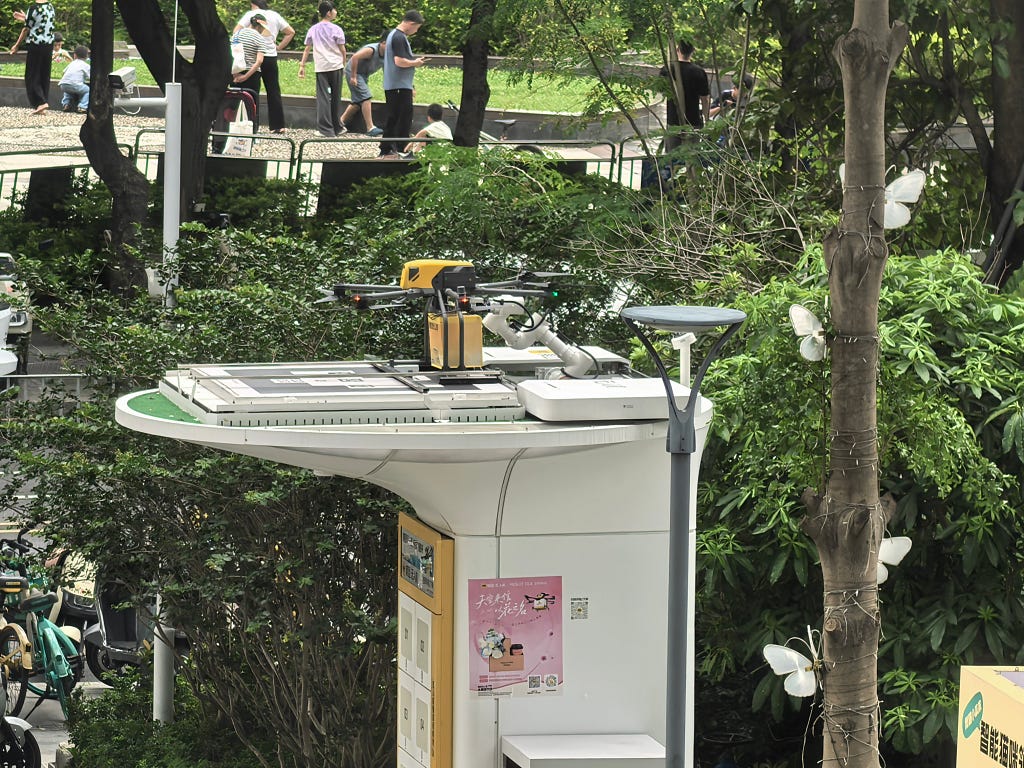
At the station, a Meituan delivery worker brings food, weighs it, and places it into a compartment that looks a little like a coin locker. Then the drone arrives, and a robotic arm loads the package onto the drone. From above, it is easy to see how the drone lands, how QR codes help positioning, and how the package is attached or detached.
It looked futuristic, but not perfectly polished. Some cable handling still felt like a prototype. During my visit, ordering stopped for a while because of a system update. But this is exactly what made it interesting. It was not a staged demonstration. I stayed near the station for about an hour and saw multiple arrivals and departures. It seemed to be used roughly every few minutes.
Even more interestingly, ordinary Meituan delivery workers were handling the drone shipment process. In the early stage, special staff were needed. Now the operation is moving closer to normal logistics work.Shenzhen’s Strength Is Unfinished Real-World DeploymentThis is the part of Shenzhen technology development that I find most important.
The system is not fully finished. It still has rough edges. But it is already deployed in the city, used by real workers, and connected to real customers. Problems are discovered in the field, and the system is improved while operating.
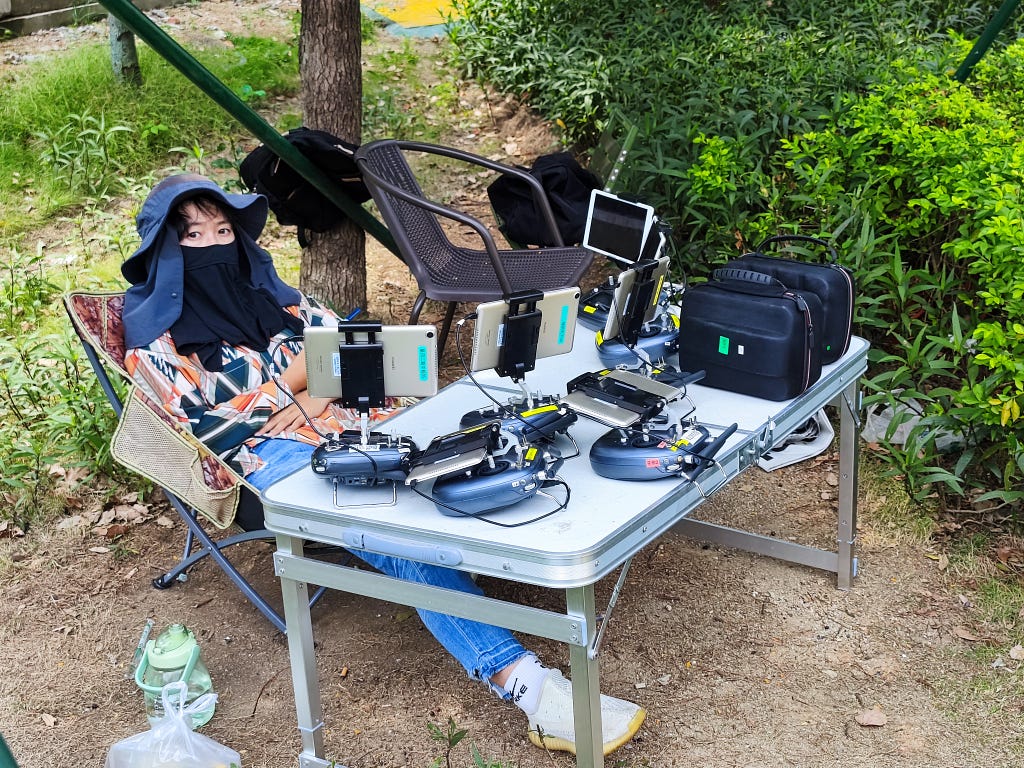
This is very different from waiting until everything is perfect before deployment. In Shenzhen, many technologies are pushed into the real world when they are just practical enough. Sometimes this causes confusion. Sometimes it creates friction. But it also creates a large-scale learning environment that is difficult to reproduce in a lab.
Drones are not yet essential to daily life in Shenzhen, but they are already part of the city. Police use them. Delivery companies use them. Regulations and restrictions are also visible. In early 2024, while I was filming a drone light show with my own drone, the police used a jammer and almost forced my drone to land. I quickly brought it back, and an officer with a jammer came over and gave me a light warning.
That kind of experience shows how deeply drones have entered the city. They are useful, but they also create new problems. They are infrastructure, but also a source of control and regulation.Drones Are Becoming Part of the AI Robotics IndustryThis year’s UAV Expo was interesting because it was not only about drones as consumer products. It was about drones as part of a broader robotics and developer ecosystem.
DJI still dominates many finished product categories, and for many users, buying a DJI drone is still the best solution. But around the world, more people want to build their own drones, optimize them for their own use cases, and control the entire system. That requires components, positioning, motors, sensors, software, education, and real-world testing.
Drones are no longer just flying cameras. They are becoming part of the AI robotics industry, part of logistics infrastructure, and part of a new layer of urban technology.
At the exhibition, some technologies still felt far from everyday reality. Passenger drones are impressive, but still hard to actually experience. Some anti-drone systems looked more like science fiction than operational products. But Meituan’s drone delivery station showed a different kind of future: unfinished, a little messy, but already working in the city.
That is the future I want to keep watching in Shenzhen. Not the polished future shown only in promotional videos, but the unfinished future being tested in streets, stations, logistics networks, and exhibition halls. That is where new technology becomes real.