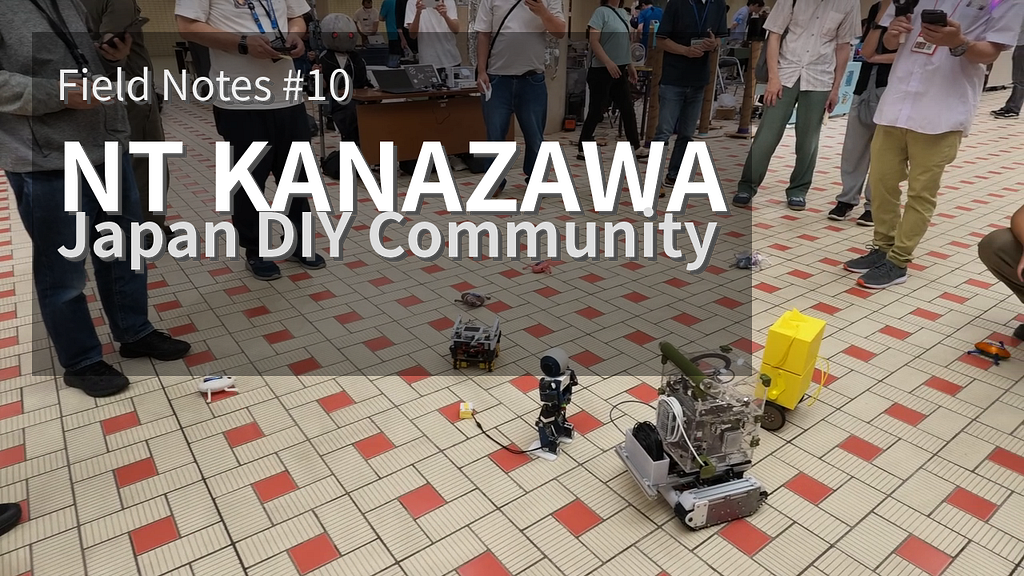
How a first-come, first-served exhibition and a public venue create one of Japan’s most distinctive maker eventsI recently published an English-language video from NT Kanazawa, a community-driven DIY and technology event held directly in front of Kanazawa Station in Japan.
In the video, I walk through the venue and introduce robots, drones, student-built hardware, interactive installations, M5Stack projects, a walking 3D printer, humanoid robots, StampFly, StackChan, and many other experimental devices.https://medium.com/media/3297346a1663e167ac26f2000b634083/hrefThe individual projects are interesting, of course. But what continues to interest me about NT Kanazawa is not simply what people exhibit.
It is the way the event is organized.What Is NT Kanazawa?NT Kanazawa is part of Japan’s grassroots NT community of DIY and technology events.
The name originated from “Nico-Tech,” a community of people who shared electronics, software, mechanical devices, robots, and other personal projects online. Local events were later organized in different parts of Japan, each developing its own character.
NT Kanazawa has become one of the largest and best-known of these events.
Its exhibits include electronics, software, robotics, mechanical projects, handmade accessories, musical instruments, interactive art, university research, commercial products, and machines that are difficult to place in any category.
Advanced engineering projects may appear next to something that a person built at home over a weekend.
That mixture is an important part of the event.No Selection ProcessOne major difference between NT Kanazawa and Maker Faire is the way exhibitors are accepted.
At Maker Faire, applicants normally submit descriptions of their projects, and the organizers select which exhibits will participate.
This process is necessary. Exhibition space is limited, and organizers must maintain quality, safety, and a coherent experience for visitors. I am also involved in organizing Maker Faire, so I understand why selection is needed.
NT Kanazawa generally works differently.
There is no formal judging process for exhibitors. Spaces are primarily assigned on a first-come, first-served basis.
A project does not need to be advanced, visually impressive, easy to explain, or closely connected to an announced theme.
You need to make something and apply before the available spaces are filled.
This simple difference changes the composition of the event.
The venue contains polished research projects, corporate demonstrations, student work, unfinished prototypes, personal experiments, and strange devices whose purpose may not be immediately clear.
They are not carefully arranged into a consistent narrative.
That lack of excessive organization is part of what makes NT Kanazawa valuable.Selection Always Creates a FilterWhenever organizers select exhibits, they inevitably create a filter.
Even when the criteria are not explicitly stated, projects that are easier to understand, easier to present, or similar to previous successful exhibits are more likely to be accepted.
Selection can improve the overall quality of an event, but it can also reduce the number of projects operating outside familiar categories.
NT Kanazawa avoids some of this filtering by accepting exhibitors in the order they apply.
As a result, the diversity of the event does not come from making “diversity” an official theme.
It comes from an operational decision not to select too much.
The event is diverse because its structure leaves room for projects that would otherwise be difficult to evaluate.Makers and Travelers Sharing the Same SpaceThe location is just as important as the exhibition system.
NT Kanazawa is held inside the Omotenashi Dome, a large public space directly connected to Kanazawa Station.
This is not an isolated exhibition hall that people enter only after deciding to attend a technology event. Tourists, commuters, families, and other travelers naturally pass through the area.
Someone walking through the station may notice a robot moving nearby and stop.
A child may begin interacting with a machine. A parent may ask the exhibitor a question. A tourist who has never heard of the event may suddenly find themselves standing in front of a homemade robot.
Makers and non-makers meet naturally in an everyday public space.
At Maker Faire, most visitors have bought a ticket and traveled specifically to see the event. At NT Kanazawa, people who did not know that a maker event was taking place can become part of it simply by walking through the station.
This creates a different relationship between makers and the public.
Maker activity is not placed in a separate world that people must deliberately enter. It appears inside ordinary life.A Robot Among Ordinary PeopleThe event’s physical openness also affects the projects themselves.
Robots and small drones operate near children, families, and people carrying luggage through the station. Exhibitors have to think not only about whether a machine works, but also about how it behaves around people who may not understand it.
This is a very different environment from a laboratory or a closed technical exhibition.
A robot moving through NT Kanazawa is immediately tested as part of a shared public space.
Can people understand what it is doing?
Will children approach it?
Does it create interest, confusion, or fear?
How should the operator respond when a person who knows nothing about robotics begins asking questions?
These interactions are difficult to reproduce in a controlled demonstration.NT Kanazawa Is Getting BiggerNT Kanazawa has grown considerably in recent years.
Companies such as M5Stack, JLCPCB, and Seeed Studio now participate alongside individual makers, universities, students, and community organizations.
It is no longer easy to describe the event only as a small local DIY gathering.
Growth can create problems for grassroots communities.
Large corporate booths may become more visible than individual projects. Product promotion may replace experimentation. Small and unfinished projects may begin to feel out of place.
NT Kanazawa may eventually face those challenges.
For now, however, its growth seems to be moving in a positive direction.
Corporate exhibits have not replaced personal projects. They have been added to the same mixed environment.
A company booth may stand next to a student project, an independently developed robot, or an experimental device brought into the event’s drop-in exhibition area.
Companies are present, but they are still only one type of participant among many.Companies as Participants, Not the CenterThis balance matters.
Corporate participation can bring resources, products, technical knowledge, and new visitors to a community event. The problem begins when companies redefine the event around themselves.
At NT Kanazawa, the original mixture is still visible.
The event has become larger, but there remains space for a person to bring something made simply because they found the idea interesting.
There is still room for experiments that are unfinished, difficult to explain, or commercially meaningless.
As long as that space remains, growth does not necessarily weaken the event.
It can make the mixture richer.What You Can See in the VideoIn the video, I walk through the entire venue and introduce projects including:Robots and drones moving among visitorsStudent-built hardware and software projectsA walking 3D printer and plotterA highly detailed humanoid robotStampFly with optical-flow supportTouch-responsive projection mappingLEGO models of M5Stack devicesStackChan robots and other M5Stack community projectsExhibits from M5Stack, JLCPCB, Seeed Studio, and othersEach project has its own story.
However, the larger subject of the video is the environment that allows all of these projects to appear together.
Advanced research, commercial products, student work, personal experiments, and unfinished prototypes occupy the same public space without a clear hierarchy.
Between them walk not only dedicated makers, but ordinary people using Kanazawa Station.Diversity Is Produced by the StructureAn event does not become diverse only by inviting different categories of people after the program has already been designed.
Diversity is affected by more basic decisions:
Who is allowed to exhibit?
How are they selected?
Where is the event held?
Can people enter without planning to attend?
Are small and unfinished projects still welcome after companies begin participating?
NT Kanazawa provides an interesting answer to these questions.
Its diversity is produced by a combination of low barriers to exhibiting, a public location, and a willingness to let different kinds of participants share the same space.
The event is becoming larger and more professional.
So far, however, it has not lost the disorder that makes it interesting.
That disorder may be one of its most important strengths.https://medium.com/media/3297346a1663e167ac26f2000b634083/href