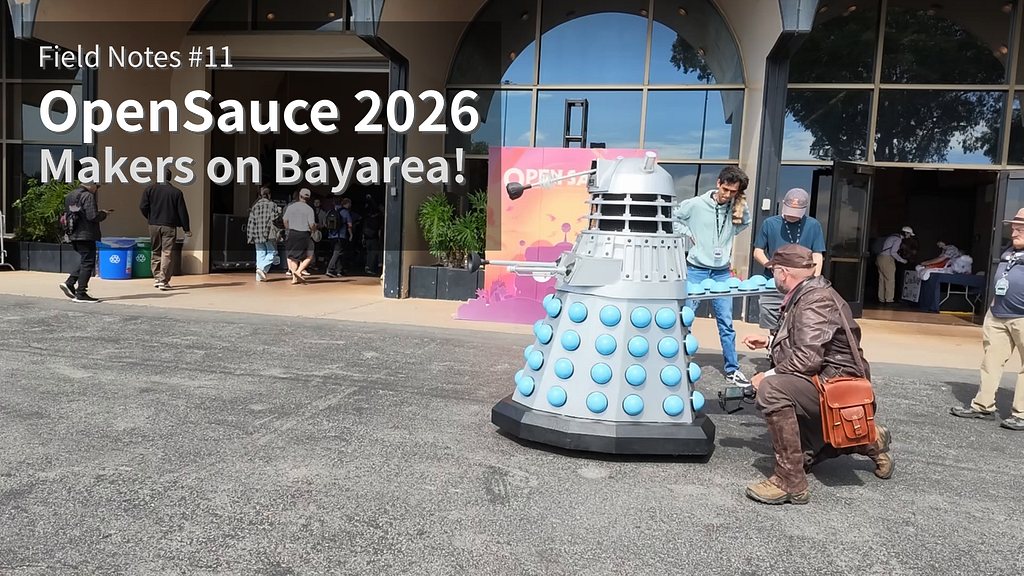
Walking through Open Sauce, where NASA, BattleBots, student projects, open-source hardware, and unfinished experiments share the same hallsI recently visited Open Sauce, a large maker, science, technology, and DIY event held at the San Mateo County Event Center in California.
I also recorded a complete English walkthrough of the event:https://medium.com/media/9a0555148e9644f32ba0f9f1fbaad45f/hrefOpen Sauce is difficult to describe using only one familiar category.
It is partly a Maker Faire, partly a science festival, partly a startup exhibition, partly an indie game arcade, and partly a very large garage sale.
Across four halls, I found personal electronics projects, university research, hardware startups, hackerspaces, game developers, fabrication tools, NASA, giant drones, humanoid robots, and BattleBots.
The scale was impressive.
But after walking through the entire event, the thing I remembered most was not the size of the machines or the number of exhibitors.
It was the strong desire people had to show what they had built.Four Halls of Different Kinds of MakingThe video begins with a look at the event map and the four main exhibition halls.
00:50 — The event map and exhibition halls
Near the entrance were vehicles from GM, followed by 3D printers, plotters, analog electronics, mechanical devices, and projects made from recycled or reused parts.
01:14 — GM vehicles and the main DIY area
01:26–3D printers, plotters, and analog machines
The exhibits were not arranged into one clean technological narrative.
A national laboratory could be located next to a circuit-board manufacturer. A polished commercial product might sit beside a strange machine built at home.
It felt less like a conventional trade show and more like a very large warehouse where everyone had brought something they wanted to demonstrate.
That mixture was one of the event’s strengths.National Laboratories and Weekend ProjectsAt around three minutes into the video, I visited an exhibit from Los Alamos National Laboratory.
03:16 — Los Alamos National Laboratory and PCBWay
Nearby were PCBWay, retrocomputers, LED projects, and people wearing electronics they had made themselves.
A little later, I reached Framework Laptop.
04:08 — Framework Laptop and hardware sponsors
Framework is known for designing laptops that can be repaired, upgraded, and kept in use for a long time. I had followed the company for years, but this was one of my first opportunities to examine its hardware closely.
Next was Seeed Studio.
04:55 — Seeed Studio’s open-source robots
Seeed Studio brought several open-source robotics projects, and its founder, Eric Pan, was also at the event.
Companies connected to China, and particularly Shenzhen, were visible throughout the venue. Seeed Studio, PCBWay, and NESTWORKS were all present.
American maker communities and Shenzhen’s manufacturing ecosystem are no longer separate worlds.
Projects designed in the United States use circuit boards and components made in Shenzhen. Shenzhen hardware companies attend American events to meet developers and introduce new tools.
At Open Sauce, this relationship appeared as an ordinary part of the event.Repair, Reuse, and Making Things LastThe iFixit area begins at around 5:40.
05:40 — iFixit, repair culture, and recycled plastic
iFixit is known for publishing repair guides, disassembling products, and selling tools and replacement parts.
At Open Sauce, its presence extended beyond repairing existing products.
One project turned discarded plastic and medical waste into new sheets of material using heat and pressure.
Repairing a product, extending its useful life, and finding another use for discarded materials are often discussed as separate topics.
Here, they were connected.
Later, iFixit also supported a soldering workshop where visitors could assemble a small circuit themselves.
19:33 — The iFixit-sponsored soldering workshop
Open Sauce was not only a place to look at finished products.
There were many places where visitors could use tools, solder components, play games, operate machines, or interact directly with projects.Scientific Research in a Public Maker EventOne section included demonstrations related to quantum computing, superconductivity, dark matter, and other areas of scientific research.
06:51 — Quantum computing and scientific research
Not every visitor could understand every detail.
That was not necessarily the point.
Researchers stood beside their equipment and posters and explained their work to people who might have no specialist background.
Later, Caltech students exhibited rocket projects.
20:05 — Caltech rockets and student engineering
NASA also had a large presence in the robotics hall.
21:33 — NASA and the main robotics hall
What interested me was that these research projects were not isolated in a separate academic area.
NASA, university projects, personal robots, 3D-printed parts, and hobbyist electronics all occupied the same event.
Advanced science was presented as another form of making.“We Made This, and We Want You to See It”The student and education area begins around 11 minutes into the video.
11:09 — Schools, Hack Club, and student projects
Students wearing matching shirts stood beside their projects and explained them to visitors.
The technical level varied considerably.
Some exhibits were serious university research projects. Others looked like a student’s first experience with Arduino, sensors, or mechanical design.
However, almost every booth communicated the same message:
We made this, and we want you to see it.
This was one area where I felt a difference from many Japanese exhibitions.
In Japan, people often want to improve a project further before showing it. They may wait until it operates reliably, looks presentable, and can be explained correctly.
At Open Sauce, many people brought projects while they were still in progress.
If something stopped working, they repaired it at the booth.
If the explanation was not perfect, they explained it anyway.
This does not mean that every American project was technically more advanced. It clearly was not.
The difference was that showing the project seemed to be understood as part of developing it.
Visitors reacted, asked questions, laughed, became confused, or suggested another use. That feedback became part of the next version.Games Are Maker Projects TooRedwood Hall was largely dedicated to games.
12:41 — Indie and homemade games in Redwood Hall
Individuals and small teams brought games they had developed and let visitors play them immediately.
The hall felt more like an arcade than a software exhibition.
These games were not presented only as digital products distributed online. They were treated as things people had made and wanted others to experience.
One particularly memorable example was a card game based on the difficult-to-pronounce names of IKEA products.
09:17 — A card game based on IKEA product names
Serious research and deliberately silly ideas could appear at the same event.
Neither needed to justify its presence by being useful.Hackerspaces, Music, LEDs, and Interactive ArtNoisebridge, the well-known San Francisco hackerspace, also participated.
09:33 — Noisebridge and solenoid-powered music
One project used a Raspberry Pi and solenoids to create physical music.
The dark-room area contained LED installations, sound projects, sensors, and interactive artwork.
10:11 — LEDs, sound, and interactive installations
Some of these exhibits are difficult to describe in writing.
A DJ booth became a large pixel-art display. Light changed in response to movement. Mechanical parts produced sounds.
This was one reason I filmed the event as a walkthrough rather than only taking photographs.
The environment was part of the project.The Tools and the Things Made With ThemThe fabrication area included Snapmaker, 3D printers, laser cutters, CNC machines, and other large tools.
13:51 — Snapmaker and fabrication equipment
NESTWORKS from Shenzhen was demonstrating a CNC machine under development.
15:27 — NESTWORKS CNC machines
Nearby were university engineering projects, student robots, a giant Game Boy, and a mechanically modified piano.
Other booths focused on CAD software, Meshtastic, KVM systems, hardware tools, and remote-control technologies.
17:21 — Hardware tools, CAD, Meshtastic, and KVM
At Open Sauce, the tools used to make projects and the projects produced with those tools appeared side by side.
Someone developed a CNC machine.
Another person used a CNC machine to produce a robot part.
Someone built a communication system.
Another exhibitor used that system inside a completely different device.
The infrastructure of making was visible together with its results.Giant Drones, Humanoid Robots, and BattleBotsThe final major hall was dominated by robotics.
There were FPV drones, robot-fighting projects, VR-controlled machines, humanoid robots, student teams, and NASA exhibits.
At around 22:41, I encountered a drone large enough to carry a person.
22:41 — Giant drones and humanoid robots
Beyond it were BattleBots teams and their machines.
22:57 — BattleBots teams and machines
The robots were built to collide with and damage one another.
After a match, they had to be repaired and prepared to fight again.
Once again, the focus was not on keeping a completed object clean and protected.
The machine was built to operate, fail, break, and be rebuilt.
The robots varied enormously in scale, purpose, and technical sophistication.
But every team brought its machine forward, explained it, and wanted people to watch it move.Some Things Exist Because Someone Wanted Them to ExistNear the end of the walkthrough, I found a converted Japanese fire truck, electric bicycles, a moving sofa, a mobile umbrella, and a rocket-powered skateboard.
24:29 — E-bikes and a converted Japanese fire truck
25:27 — A moving sofa, mobile umbrella, and rocket skateboard
Why should a sofa move?
Why should an umbrella drive itself?
Probably because somebody wanted to make it happen.
At a maker event, that is a sufficient reason.Showing Is Part of BuildingThe exhibits at Open Sauce were not all at the same level.
A major scientific institution might be located near a student’s first electronics project. A funded startup might stand beside a personal experiment with no commercial purpose.
But they all showed their work in the same halls.
That was the strongest impression I took from the event.
People did not always wait until a project was finished before presenting it.
They showed it while it was still developing.
They allowed people to touch it, ask questions, misunderstand it, enjoy it, or break it. Then they repaired it and continued.
Open Sauce was not simply an exhibition for evaluating completed technology.
It was a place where the process of making was opened to the public.
The full video is about 26 minutes and covers almost every hall.https://medium.com/media/9a0555148e9644f32ba0f9f1fbaad45f/href