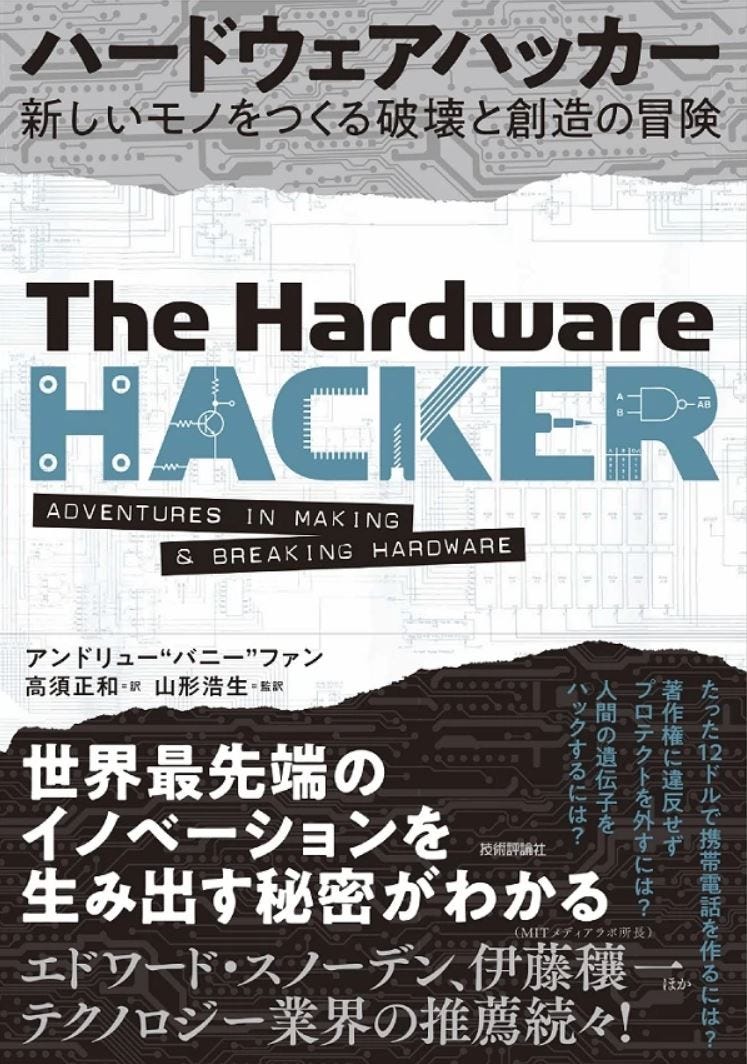
Where Does Your Curiosity Come From?I am very happy and honored that The Hardware Hacker by Andrew “bunnie” Huang has been chosen as a reading assignment for a seminar at the Interface Device Laboratory at Kanazawa University, where I currently belong.
This book is personally meaningful to me because I am the Japanese translator of The Hardware Hacker. Seeing a book I translated become part of an academic discussion in my own lab is a very special experience.
Bunnie Huang will also be visiting Japan for NT Kanazawa. So I wanted to take this opportunity to reflect on why this book still matters — perhaps even more — in the age of AI.One of the First Hardware StartupsBunnie was Vice President of Hardware at Chumby, one of the earliest hardware startups.
Around 2006, he went to Shenzhen, China, at a time when the term “hardware startup” was not yet common. Back then, few people imagined that an American team without strong local connections could manufacture its own consumer hardware at scale in China.
When he first stepped into Huaqiangbei, Shenzhen’s electronics market, he encountered mountains of components and an ecosystem where parts could be bought through direct negotiation. That experience became the beginning of his long relationship with Shenzhen.
Unlike the Western business environment he had known, Shenzhen’s hardware ecosystem was driven less by formal contracts and lengthy coordination, and more by cost performance, physical constraints, and practical execution.
Bunnie once said that with the budget for one night at a hotel during CES in the United States, he could stay in Shenzhen for a month. He deliberately chose places where few people spoke English, almost like a monk in training, in order to deeply understand the local ecosystem.
Chumby eventually succeeded in mass production and gained a certain level of market acceptance. But it did not become a long-term commercial success. Bunnie later wound down the project.
What makes The Hardware Hacker valuable is that it does not only describe the excitement of making hardware. It also describes manufacturing decisions, compromises, failures, and even the process of ending a startup.
Very few books tell the whole story of a hardware startup from creation to closure.After ChumbyAfter Chumby, Bunnie remained based in Singapore and continued to work closely with Shenzhen.
His company, Sutajio Kosagi, reflects even in its name his affection for Japan. He went on to create many more projects, advise hardware startups, and more recently even bring a chip of his own design into the world.
Many of his post-Chumby projects were not major commercial successes.
But that is not the point.
They were driven by his curiosity: the desire to make things, and to understand the world by making them.The Difference Between a Talented Human and AIRegardless of whether a project succeeds or fails, Bunnie’s journey to understand hardware continues.
He is intellectually and physically energetic. He works on many projects with a level of stamina that almost seems machine-like. He has a Ph.D. in computer science from MIT, and when he identifies a technical problem, his thinking is sharp and precise.
And yet, his work is deeply personal.
After stepping away from the startup path and moving toward smaller projects and contract-based work, he has described his life as less financially rich than before, but much more independent.
The contrast, as he once put it, was between golden handcuffs and an Aeron chair, versus a backpack and a distant goal chosen by himself.
That independence is essential.
Today’s AI does not age, get sick, or die. It is not a living organism. Even if its intelligence can resemble ours in some ways, it is fundamentally different from a mortal human being.
AI also requires hardware to run, but that hardware is not owned by the AI itself.
My local AI runs on my PC. Claude Code runs on Anthropic’s infrastructure. Whether open source or provided as a commercial service, AI tends to serve the goals of whoever owns and operates the system. It also seems almost instinctively optimized to conserve computational resources.
Bunnie’s actions, by contrast, are full of “waste” in the best possible sense.
He goes toward things that are unknown, undocumented, or that nobody has tried before. He spends time and energy not because it is efficient, not because it is profitable, and not because it is likely to go viral, but because he wants to know.
He also cares deeply about being the owner of himself.
If the theme were simply “a highly capable person solving technical problems,” then AI and humans might appear increasingly similar.
But The Hardware Hacker is full of experiences that could only have come from Bunnie himself.
The questions begin from his own curiosity. The results return to his own satisfaction.
That is the hacker spirit.Curiosity as a Human QualityOf course, Bunnie’s work often has social value. It contributes to open source, the maker movement, hardware transparency, and broader discussions about technology and society.
He also has clear views on how the world should move forward.
But even when there is a social mission, a measurable goal, or something that might look like an objective function, I feel that the difference between his work and AI will remain difficult to erase.
Curiosity is connected to human instinct.
It is an expression of intelligence, but it is also tied to the life and death of being a living organism.
Curiosity can arise from business goals, corporate needs, or the desire to gain attention. Those forms of curiosity are real. But they may also become easier for AI to replace.
What may matter more in the AI age is curiosity that comes from oneself.
The desire to understand by making.
The desire to understand by taking things apart.
The energy to continue not for money, success, or recognition, but simply because one wants to know.
That, I believe, is one of the most important human qualities in the age of AI.
And that is why I think The Hardware Hacker is worth reading today.